Among the very best b-sides of them all. The other side of 1983's This Charming Man, with a truly wonderful cover shot of Jean Marais, taken from Cocteau's 1950 film Orphee. Don't knock The Smiths!
Sunday, June 21, 2015

Songs About People # 97 Bob Dylan

And the second song posted below took me here. To David Peel & the Lower East Side who somehow managed to get themselves a deal with Elektra Records in the late sixties, partly thanks to great punk mover and shaker Danny Fields, and sell the best part of a million records or more of this kind of decidedly low-fi stuff. A real forerunner of Punk and of course what Lewis himself does now. Here's Peel's tribute to Bob from his 1972 album The Pope Smokes Dope.
Song(s) of the Day # 518 Jeffrey Lewis
Psst! It's Sunday morning. Would you like a musical, rhymed, potted history lesson of the fall of the Soviet Union from a New York based indie singer-songwriter? Accompanied by his own comic illustrations? Hope so, because here it is. If you care for this you may also find interest in Lewis's history of Rough Trade Records and Complete History of Punk Rock on the Lower East Side 1950-1975. In fact, I'll make it easier for you. Here's the latter...
Saturday, June 20, 2015

B Sides # 4 Prefab Sprout
About that Diana.' It's about the deification of a girl' remarked Paddy McAloon in 1984 of his song about the tabloid press' fawning elevation of their then-favourite Royal, and erm, the fact that she 'smells of apple strudel.' B-side to When Love Breaks Down and like everything McAloon was putting out round about then, quite distinctively theirs.
Friday, June 19, 2015
Song(s) of the Day # 517 Judy Henkse
I think I've had one of those great Charity Shop related finds! £2.99 in Oxfam, Canterbury. 5p for the bag. Judy Henske. Queen of the Beatniks. Released on Elektra Records in the early sixties. Always a good sign. The liner notes read:
'Judy Henske is a Christian artist and a bitchin' singer...she must be six feet tall...a 'neat' performer...a snorting, long-legged, foot-stopping improvisation...Three years ago, or so, Judy Henske sat on the keyboard of a player piano in the espresso darkness of the Unicorn...L.A.Hollywood, Sunset Strip, Calif...sandal feet propped on a cane-backed chair...long dark tresses swinging and dangling as her head nodded with the rhythm...she belted out Twelve Gates To The City in a voice that tromboned a destiny soon to be fulfilled...You hold in your hands the first thin wafer taste of what life will develop into the gratifying and enduring feast of Judy Henske...'
The rest of the notes are worth reading too. Three dots separate each over-excited statement. I'll leave that to your record shopping. As for the record itself, possibly the best £3.04 I've ever spent. If I had a chance to live in another age and time, a question I suppose we all ask ourselves at some point, New York in the early sixties would be right up there. Beatnik bohemian bars, Don Draper on an adjoining table barely concealing his disdain, Judy Henske type on the low stage. Something coming to an end. Something just about to begin.

Covers # 11 Tir Na Nog
And on the subject of Nick Drake and Pink Moon, here's a cover of one of the songs off it by an Irish duo from their 1973 album debut. Peter Paphides, who talks about it on a feature on Drake on the John Peel archive website, thinks it's wonderful. I'm not entirely sure myself though I do see the connection he makes with the marauding quality of the early Roxy Music records.
June 19th 1948 Nick Drake
As was pointed out to me yesterday, this is an awful album cover. Nevertheless, a very good record.
Songs About People # 96 Meg White

Having taken a slight, sideways swipe at The White Stripes on here just now here's a great love letter to their drummer from Ray LaMontagne.
B Sides # 3 Violent Femmes
Gordon Gano, Jonathan Richman's wayward younger brother. B-Side to Ugly, quite the weakest of their early batch of songs, which came out between their first album and their second. This though is among the very best of them. Biblical. Gano's inability to allow any boundaries to his hormonal raging put him in a category all of his own. No-one else came close. I imagine Dad said no.
Song(s) of the Day # 516 J. Geils Band

Magic Dick - Lord of the Licking Stick!
Writer Nick Hornby was ahead of the curve in some respects when he first starting putting books out two decades back or more although I still have some trouble reading his stuff owing partly to his specific tastes in both football and music and my own personal prejudices in those respects. I'm sure Hornby himself would understand. Still, he was in many ways the big daddy of all us blog ranters, banging on ceaselessly about his pet obsessions without regard for actually being liked by the reader and unapologetic about his tastes and himself.
He also has great, undeniable strengths of course, particularly in terms of his precision, most obviously in his first two books, Fever Pitch and High Fidelity, in nailing certain characteristics of the adult, British male. Maybe the conclusions he came to apply elsewhere too, but I can only speak authoritatively from personal experience for these isles. In particular he hit bulls-eyes in terms of male neediness, our difficulties with the opposite sex, our tendency to make lists, our often illogical and unswerving allegiance to particular sporting clubs, our unshakable sense of certainty that our taste in music is, after all, better than anyone else's. And that's just for starters.
Nevertheless, he gets some things wrong. He supports Arsenal, after all and proceeds to keep banging on about it and them in interminable length and detail throughout the pages of Fever Pitch as if this in itself makes him by default some kind of deserving object for sympathy or pity from those who might not share his particular object of affection. Arsenal Football club, as those even vaguely in the know will realise, are one of the more enduringly, successful institutions in English footballing history. Arsenal fans don't need or deserve a shred of either sympathy or empathy from the rest of us. Their team will no doubt win something this season. If not, the next. The rest of us should be so lucky! As for those who don't even like the sport. God only knows what they think!
.
In High Fidelity and most recently in 31 Songs, his written collection of his favourite songs and the memories and emotions they evoke, he did us male music lovers an even greater disservice. He saddled us, by association, with a mainstream, contented and slightly self-satisfied perspective on life and music. There's more to life than Badly Drawn Boy, Teenage Fanclub and Aimee Mann Nick! Jackson Browne puh-lease!
He does pick some good stuff too of course. The book's well worth a read despite this caveat and there are of some notable sections of excellent writing. For example this passage about his first trip to The States as a teenager and how he fell in love with all things American, including the J.Geils Band:
'My father's friend had a son called Danny, who was older than me , maybe twenty or twenty-one and he had long hair and a moustache; he looked exactly like Danny Crudup in Almost Famous. Danny loved his music, and the music I was listening to when I went round to his house for the first time was the live J.Geils Band album Full House. I'd never heard of them, and I'd never heard anything like them: in those days, before they had a big pop hit with 'Centrefold',they played white boy R&B, like The Stones in 1965, but much louder and much faster, with a beserk irreverence and an occasionally terrifying intensity. On the live album, Peter Wolf, the lead singer, shouted out funny, weird or incomprehensible things in between songs: 'On the licking stick Mr Magic Dick!' 'This used to be called "Take Out Your False Teeth Mama.......I Want To Sssssuck On Your Gums" and something that sounds like 'areyougonnagettitmoodogetitgoomoogetitmoodoogoomooomoogetitalldowngetitallrig htgetitoutofsightandgetitdownbaby?' The first thing you hear on the record is a solid slab of crown noise, whistles and cheers and screams, and then a shouted and very un-English introduction from an MC 'Are you ready to get down? I said are you ready for some rock and roll? Let's hear it for the J.Geils Band!'
Nick Hornby - 31 Songs
The J.Geils Band at their peak was a pleasure that was largely denied to British audiences. As Hornby mentions above they only really struck it big here ten years later when they had a couple of Top 20 hits in the early eighties with Centrefold and Freezeframe and toured with The Stones. They were past their best then, Centrefold is a particular embarrassment to listen to now, but Hornby is right in that they were clearly a force to be reckoned with in the early Seventies. On one occasion, the legendary rock critic Lester Bangs played typewriter onstage with them during an encore proceeding to smash it to bits at the end of the song. He wouldn't have done that with just anyone. Possibly, reading Bang's stuff again this week he might have done, so rampant was his ego.
In any case, I've posted a selection from their fine first two studio albums here as well as one of the tracks from the Full House live album that Hornby alludes to above, which interestingly also gets a name-check in the Big Star review I put up a couple of days back and clearly was a staple for American record collectors in the early seventies and the band themselves, something of an institution.
Thursday, June 18, 2015
Covers # 10 The Black Keys
After a great hour listening to The Black Keys talking about their inspirations yesterday, (see post below), I tried to track down something of interest among their own recordings but thus far sadly without success. Strangely, for a band striving for the sound they're after, as with The White Stripes, what actually comes across to me is their inauthenticity. Still, I'll keep trying. In the meantime, I did like this. More, (partially at least), inspiration. She Said She Said, re-imagined by Hendrix. Nicely done.
Songs Heard on the Radio # 60 Spooky Tooth
I always had a feeling there'd be something by Spooky Tooth I would like. Just chanced upon at least one thing thanks to Marc Riley.

Songs About People # 95 Timothy Leary

American psychologist and advocate of the 'turn on, tune in, drop out', mantra of the west coast in the mid to late Sixties get's an extended, period piece tribute from The Moody Blues in 1968. Leary was later described as 'the most dangerous man in America,' by Richard Nixon if a further testimonial is required.
Playlists # 1 The Black Keys
Always interesting to hear musicians play a load of records they love and talking about it. Not quite got round to The Black Keys yet but their taste is so great I'll have to give them another listen. What they say about the records is also worth hearing. Here's the link. And here's the list:
1. Pavement - Texas Never Whispers
2. Dr. John - Jump Sturdy
3. Galaxie 500 - Strange
4. Rick Nelson - Hello Mary Lou
5. The Beatles - Come Together
6. The Reigning Sound - If You Can't Give Me Everything
7. Television - Elevation
8. Bo Diddley - She's Fine, She's Mine
9. The Feelies - Raised Eyebrows
10. Dale & Grace - I'm Leaving It Up To You
11. Captain Beefheart & his Magic Band - Grow Fins
12. Prince Conley - I'm Coming Home
B Sides # 2 Nirvana
Flip side to Heart Shaped Box and as far as I know the first David Grohl song released. Obviously written in Cobain's enormous shadow but nevertheless a nice start.
Death # 3 - Jan & Dean
I could have put this in the just completed Be My Baby series. It has pretty much the same drum track and indeed the same drummer Hal Blaine and band, the legendary Wrecking Crew team of LA studio musicians. But perhaps it slots more comfortably in the 'death' category. Remarkably cheery given the subject matter. Also geographically quite specific, detailing the route from Sunset Strip to the notorious curve in the road an almost 90 degree turn in the road on Sunset Boulevard just past North Whittier Drive.. Of course the song was given added poignancy and mystique when writer and band leader Jan Berry had his own near fatal accident a couple of years later not far from the very same spot which derailed the duo's career. Racing cars was a real American teenage phenomenon, rites of passage and distraction from boredom, never mind a source of fictional twists in the late Fifties and early Sixties from Rebel Without a Cause to American Graffiti to Grease to this that's probably worth a book chapter of its own if it hasn't already been written. And the message is, 'Don't do it kids!'

'I was cruisin' in my Sting Ray late one night
When an xke pulled up on the right
And rolled down the window of his shiny new Jag
And challenged me then and there to a drag
I said, "You're on, buddy, my mill's runnin' fine
Let's come off the line now, at Sunset and Vine
But I'll throw you one better if you've got the nerve
Let's race all the way
To Dead Man's Curve"
Dead Man's Curve, it's no place to play
Dead Man's Curve, you best keep away
Dead Man's Curve, I can hear 'em say
Won't come back from Dead Man's Curve
The street was deserted late Friday night
We were buggin' each other while we sat out the light
We both popped the clutch when the light turned green
You should of heard the whine from my screamin' machine
I flew past Labrea, Schwab's, and Crescent Heights
And all the Jag could see were my six tail lights
He passed me at Doheny then I started to swerve
But I pulled her out and there we were
At Dead Man's Curve
Dead Man's Curve, it's no place to play
Dead Man's Curve
Well, the last thing I remember, Doc, I started to swerve
And then I saw the Jag slide into the curve
I know I'll never forget that horrible sight
I guess I found out for myself that everyone was right
Won't come back from Dead Man's Curve
Dead Man's Curve, it's no place to play
Dead Man's Curve, you best keep away
Dead Man's Curve, I can hear 'em say
Won't come back from Dead Man's Curve'
And rolled down the window of his shiny new Jag
And challenged me then and there to a drag
I said, "You're on, buddy, my mill's runnin' fine
Let's come off the line now, at Sunset and Vine
But I'll throw you one better if you've got the nerve
Let's race all the way
To Dead Man's Curve"
Dead Man's Curve, it's no place to play
Dead Man's Curve, you best keep away
Dead Man's Curve, I can hear 'em say
Won't come back from Dead Man's Curve
The street was deserted late Friday night
We were buggin' each other while we sat out the light
We both popped the clutch when the light turned green
You should of heard the whine from my screamin' machine
I flew past Labrea, Schwab's, and Crescent Heights
And all the Jag could see were my six tail lights
He passed me at Doheny then I started to swerve
But I pulled her out and there we were
At Dead Man's Curve
Dead Man's Curve, it's no place to play
Dead Man's Curve
Well, the last thing I remember, Doc, I started to swerve
And then I saw the Jag slide into the curve
I know I'll never forget that horrible sight
I guess I found out for myself that everyone was right
Won't come back from Dead Man's Curve
Dead Man's Curve, it's no place to play
Dead Man's Curve, you best keep away
Dead Man's Curve, I can hear 'em say
Won't come back from Dead Man's Curve'

Song(s) of the Day # 515 World of Twist
Retro futuristic chic from twenty five years back. World of Twist were much rated by critics, deejays and fellow musicians at the time and since but failed to match that acclaim with much real chart success or record sales. Their 1990 Quality Street album is worth hearing, I had the sense to buy it at the time, but really these two singles tell their story as well as anything. As distinct from the pack as Associates had been with Party Fears Two and Club Country almost ten years before and Roxy Music with Virginia Plain and Pyjamarama ten years before that, these should both have been Top Twenty hits. They probably influenced nobody but it's sometimes just easier to copy the obvious stuff.
Wednesday, June 17, 2015
Waitakere Walks - Velvets

Please find links to a great, late Velvet Underground article from 1970 in Circle Magazine at the Waitakere Walks blog listed on the right-hand margin of this one. Or alternatively, here.
Song(s) of the Day # 514 Brinsley Schwarz
Brinsley Schwarz are known for a number of things. Being named after their guitarist. Emerging from the ashes of a Sixties band called Kippington Lodge. An infamous marketing exercise, hatched by Dave Robinson who later went on to form Stiff Records, where a busful of journalists were sent out to New York in April 1970 to watch them play support to Quicksilver Messenger Service and Van Morrison at the Fillmore East in New York City. The plot backfired entirely, the journalists for the most part got stinking drunk on the excursion's rider and proceeded to slate the band in their resulting reviews almost leaving Brinsley Schwarz dead in the water before their career had even really started.
They're also of course known as the platform from which Nick Lowe first started to make his mark as second guitarist and main songwriter. I'd recommend their second album Despite It All, which they recorded and released later in the same year. Vinyl copies of which will fetch you the best part of £30 if you're lucky. Records tend to find their own price. It has the fingerprints of Van, The Flying Burritos and Crosby, Stills & Nash all over it but it's a good listen coming as it seems to do from an altogether slower, more laid-back and contented time.
They went on to become mainstays of the London Pub Rock scene. Lowe ended up on Stiff and became a punk rock producer. Here are four songs from that second record. Nice cover too!
Tuesday, June 16, 2015
Bruce Eaton on Radio City by Big Star

One day I'll write at length about Big Star on here. But it won't be about Radio City, their second and I think best record as Bruce Eaton, (in his book about the album which forms part of the wonderful 33 1/3 series), has got there before me and written about it better than I ever could. In addition to that, this is as good a piece of music criticism as I know. About the whole lore of record collecting and record shops.About what it feels like to stumble across a piece of music that changes your life. About being utterly smitten by something the first time you hear it. About wishing to share your new found love with others. And about trying to describe that beloved object years after the event to a wider public than your own personal circle. By the way, the Radio City album is every bit as good as Eaton's feverish prose makes it out to be. Here's the introduction to the book:
_________________________________________________________________________________
'The light of the vinyl junkie is that most days you have to settle for something less than great. Like a true wax fanatic, it was psychically impossible for me to leave a record store empty-handed. Entering Play it Again, Sam I'd conduct a ritualistic search, starting with a beeline for the new releases bin, hoping it contained heretofore unseen treasures of black gold. If there were a couple of hot new imports along with a rare bootleg to top off the haul the day might be as good as Christmas. More often than not, there would be the same exact records as the day before. That meant that there was work to do.
Play it Again, Sam specialised in used records - sorted and priced by a combination of condition and desirability and marked accordingly by a colored dot sticker. You'd start by combing through the red dots - the primo records that sold for two dollars and fifty cents.Here you'd find the latest releases that had been traded in by a local record promo man for his pizza and gas money. If you didn't find anything in the reds, you'd slide over to the two dollar blue-dot bins.,maybe settling for a used J.Geils Band album you'd once owned in college and had passed over on your previous 34 visits. If you still weren't in the mood to hear Full House again, you'd have to take desperate action and thumb through the dollar fifty yellow-dot bins. It was here you'd find the records that were one step from being put out to curb - either worn out and abandoned college dorm hits of yore (Carole King and Cat Stevens lived here), albums that even an artist's hard-core fans couldn't swallow, (Steven Stills was releasing direct-to-yellow-dot at that point), or records that for one reason or another never garnered a following (April Wine were the Led Zeppelin of the Yellow Dots).
On this particular day I had made it all the way to the Yellow-Dots empty handed. Starting at the "A" bin, I flipped past Ace and April Wine, a worn copy of The Band's Stage Fright, beat up Beach Boys and Beatles albums, and the first wave of Bee-Gees trade-ins. Some of these albums had been there for months - I could almost tell you what was going to come next. And then there it was. An album I'd never seen before. Unless a record had been released just yesterday, this alone was reason to pause.Across the top it read in black letters, "Radio City Big Star" in a way that made it apparent that the album was Radio City and the band was Big Star.
If you spend enough time looking at records, you develop a sixth-sense about how good a record might bejust from looking at the cover. On first glance Radio City looked quite promising. The front cover featured a big picture of a bare light bulb against a bright red room and struck me as being at least several notches above your typical album art. It would be a few years before I knew that the photographer - William Eggleston - was a world-renowned artist and friend of the band. Curious- okay, desperate - I picked up the album.Like a vintage Blue Note jazz LP, it felt like a record made by people who cared about music and knew what they were doing. On the back cover there was another color photo -this one an informal shot of three guys - presumably Big Star - hanging out in a club (the original T.G.I. Friday's it turned out). They had an air of cool and confident informality - a band tat didn't bother with rock star poses. Below the picture was some minimal information; song titles and a few credits. Nothing rang a bell except the words "distributed by Stax," a de facto seal of approval for any self-respecting rock snob.
In the back of my mind I vaguely remembered having read something about Big Star in Creem four years earlier - that their sound was somehow connected to The Beatles (which in 1976 seemed to be way more of a thing of the past than they do today), and The Byrds, and that the reviews were positive. I had a good feeling that Radio City might be worth the six quarters.Holding the record up I caught the attention of the clerk behind the register. I was just getting to know Bill, a friendly fellow who looked like he had once been a roadie for Quicksilver Messenger Service and whose taste in music leaned toward raw Detroit rock and roll with a psychedelic edge. The sort whose opinion you might value even if you were inclined to believe that yours was the only one that mattered. I gave Bill a quizzical "what's the deal?" look. "You might like that," was his offhand response, one that would prove to be an understatement to say the least. "Take it, and if you like it, pay me next time." I secured the record under my arm and headed home.
That evening I put the record on my turntable and sat down to write a few letters. It would be dramatic to seay that hearing Radio City for the first time altered my life but the redirection came later. What actually happened is that, song by song, it pulled me in until by the end of the first side I had stopped writing and was propped back in my chair with my feet on the desk, listening as the sun set behind the woods outside my window, feeling the June breeze blowing in through the window screen. I flipped the record over to Side Two and by the time the needle reached the middle of "September Gurls" five cuts in, I was riveted. The song was, on first listen, as perfect as any two minutes and fifty-six seconds of rock and roll that I have ever heard. Three years later to the month I would be on stage at McVan's Rock Castle in Buffalo playing that very song with Alex Chilton - the guy who wrote it, sang it, and played what sounded for all the world like an entire symphony of chiming guitars.
I played Radio City over and over for a few hours (it clocks in at just over 36 minutes- unlike the interminable CDs of today, listening to an album from start to finish back then wasn't a major life commitment). I stared at the jacket - wondering who Big Star was and why Radio City hadn't risen to the top of the charts, or even crossed my path. By the time I went to sleep, I had a new favorite band, albeit one I knew nothing about. (For rock snobs, the more obscure your favorite band, the better). All I knew as that I had hit the vinyl jackpot. I had found a great record in the bargain bin.
At the time I was somewhat frustrated about the lack of information about Big Star but now I look at it as a blessing. For the next eight months or so, the only in-depth information about the band was what was stamped in vinyl. The grooves contained everything the musicians wanted me to know - a direct line of unfiltered communication. I could let the sound speak to me without any interference or preconceptions, form my own opinions and let the music fill my imagination, taking me to unexpected places. I could listen without having to decide if Big Star really was the future of rock and roll or if Radio City was the most important album of the year.
It's sometimes hard to remember but there was once a time when sound - not image, gossip and hype - was indeed first and foremost in rock and roll. When Memphis deejay Dewey Phillips spun a new 45 by a local teenager on the night of July 7th 1954, the listeners who jammed up the request lines had nary a clue about Elvis Presley Phillips himself didn't even know if Elvis was black or white (he obliquely found out by asking him which high school he attended). Elvis could have been 30 pounds of sweating human sausage packed into a bejeweled white polyester casing and it wouldn't have mattered. All that mattered was the sound of "That's All Right."
Recorded less than three miles away from the Sun Studio where Elvis had recorded his first hit, Radio City also had a singular, almost otherworldly sound that exerted a mysterious pull.
Trying to describe how a record sounds and why it grabs you can be like trying to pick up a blob of mercury off a tile floor. But here's where I would describe the visceral appeal of Radio City in a roundabout way. When I was teenager in the 1960s, my family spent a part of each summer at a beach out on the northern fork of Long Island, 90 miles out from New York City.. he sound of WABC-Am - the Top Forty titan in New York - was virtually everywhere, pumping out the Super Hits from the All-American survey around the clock. Lying on the sand in the hot afternoon sun, half-drifting off to sleep, you could always hear it half in the distance amidst the sounds of bathers and motorboats. But when you tried to zero in and follow along, your ears and brain would play tricks on you - turning a song you knew inside out into something completely different. . You might have started with something that you thought was "Help!" and before you knew it there was an entirely new-and equally perfect - song coming to life in your head, taking unexpected twists and turns. And then, like a mirage in the summer heat, it would vanish at the first sound of the Yoo-Hoo jingle that inevitably followed.
Radio City captures the sound of those illusory moments on the beach. It's as if all of the music coming out of all the luttletransistor radio speakers - Beatles, Stones, Byrds, Beach Boys, Sam and Dave, 5th Dimension, Lovin' Spoonful;, Question Mark and the Mysterians, Supremes, Young Rascals, Sonny and Cher, Four Tops, Sam the Sham, Napoleon XIV - had somehow been beamed into outer space to some distant planet and then transformed by bunch of musical alchemists into something both fresh and yet familiar and sent back to earth in a stream of glowing super-charged electrical particles by a wizard of sound. In a very real sense though that's exactly what happened. Even on first listen Radio City sounded like pure magic.
If Radio City sounded like an album that had been created in the past and then beamed to a time and place somewhere in the future for the world to eventually discover, it never really did have much of a present. It sold few copies when it was released in March of 1974 - somewhere under 10,000 is a reasonable guess. If you had a copy, the cover most likely had a promo sticker or a corner cut off.What copies there were that made there way out into the world found their way into the hands of people who played it over and over. Radio City became much sought after, and once secured, treasured. Odds are that if you had a copy, it wasn't just another record in your collection. It was a directive for a mission - you had to spread the word. You had made a point of playing it for your friends and gladly made a cassette copy hen hey shook their heads in amazement. When you met somebody who already knew about Big Star, it was like a musical handshake that made you part of an underground of true believers. A lot of those handshakes were the beginning of new bands. Some of those bands went on to enjoy the success that their inspiration had optimistically hoped for - even expected - during its brief life. If influence could be measured, Radio City would have now gone platinum many times over.
Eventually Radio City was reissued on LP and then CD- enjoying progressively far better distribution than it did upon its initial release.. Listeners across several generations around the world discovered the music - finding it to be as fresh and captivating as it was on the day it was recorded. And improbably, Big Star reunited with a retooled lineup in 1993, released a new album in 2005, and still performed on occasion before Alex Chilton's death in 2010.
The story of Big Star has been told from a lot of different perspectives - virtually all involving a familiar cocktail of tragedy, drama, Southern gothic, mojo, mystery, drugs, personal chaos, sex, booze, bad luck, youthful recklessness, mental disorder, dashed dreams and thwarted ambitions. If you're reading this book, you likely know all the stories, rumors, and outright slander repeated over and over as gospel truth in liner notes, books ad magazine articles. When offered an opportunity to correct any falsehoods, Alex Chilton responds, " I'm sure there are hundreds and thousands of misconceptions out there that I've learned just to not bother with." Bandmate Andy Hummel adds, "An awful lot of what you read in the press about over the last ten years or however long it's been since it suddenly dawned on them that Big Star existed is highly colored by who they're talking to. Generally speaking they're not talking to anyone in the band - "anyone" being sort of the creative energy behind the band. They're talking to people who were involved on the periphery. That's the story that's out there.. It's not the story of what happened with the band - it's the story of what other people say happened to the band."
What gets lost in the familiar retelling of the Big Star story is how the music and the sound came to be in the first place. A record like Radio City doesn't just appear out of nowhere via totally happy accident. Rock and roll is somewhat slave to the notion that anyone with enough desire can learn enough chords, somehow stumble into a hit record and be a star. The reality is that great records are made by really talented people (even geniuses although that word has been used enough to render it virtually meaningless) who work long and hard at their craft until the day when the magic suddenly enters the studio.
Talent - God-given natural ability - is an unpopular, even cruel notion, in a world where it's widely believed that anyone can make it to the top if they have enough ambition, blonde of otherwise. But most of us don't have great musical talent.Instead we get to buy the records and the concert tickets, write books and reviews and even play in bands that allow us to have fun and dream a bit (hopefully avoiding delusions of grandeur.
Beyond talent, there's the often dismissed importance of experience - in music and in life. Does an artist have something interesting to say and the ability to say it in a unique and interesting way? The answer is usually "Not really". One of the chief reasons that rock and roll from the 1960s and early 1970s still looms large is that its creators had deep reserves of experience to draw upon when the time finally came to go to the well in the recording studio. Take The Beatles or The Stones, Bob Dylan or Bruce Springsteen. Each knew hundreds upon hundreds of cover tunes a disparaged concept today but vital to learning how music works - and had played endless gigs trying to sell them to indifferent, if not downright hostile audiences. That experience takes patience but it can eventually get you to a point where you can write songs of your own that become a meaningful and permanent part of other people's lives. Alex Chilton, with deep family roots in the Mississippi Delta and a dad who infused his youth with jazz, may have been only 22 when Radio City was recorded, but he'd hit the road at the age of 16 - playing shows all across the country, surrounded by masters of the craft soaking up everything he could. It doesn't require any stretch of the imagination to believe that a kid who grew up listening to Mingus Ah Um and Birth of the Cool, learned how to play guitar from a Beach Boy, and got to watch Wilson Pickett and The Staple Singers burn down the house night after night is going to have a few more interesting colors in his artistic palette than a kid who grew up watching music videos in his bedroom while copping shred licks in dropped D tuning. You can't see them but you can definitely hear them.
My goal in writing this book was to shed light into how the sound got into the grooves of Radio City and why, to the confoundment of many, it never happened quite that way again. After all, the sound is why we care about Radio City, not any surrounding six-string opera. I love to pore over musical biographies and Mojo alike but one can take it to a point where the actual music becomes a mere soundtrack to an oft-repeated mythologized tale of dysfunction. Looking back some 35 years ago, I got heavily into the music of Nick Drake and Gram Parsons when their albums were being released for the first time - without knowing a thing about either of them. I don't really feel that all that's been subsequently detailed about their respective struggles has added much beyond a whit to my listening experience. If you can accept the premise that genius almost always comes with a price tag, then you're free to concentrate on why you ultimately care about the artist. In one word: music. Listen carefully and you'll hear all their personal stories buried in the grooves anyway.
Some pieces of the creative puzzle are obvious: how a song was written or a particular part recorded. Other parts of the story are below the surface or even in the distant past. When you read the words of the people who were actually in the room, in one way or another, for the creation of Radio City, you'll find a lot of dots to connect. You won't be able to draw an exact roadmap - that would be impossible - but you'll be able to sketch out a rough blueprint of how Radio City was built and why, improbably, it still stands tall nearly three and a half decades after the final note was nailed into place. The 33 1/3 series doesn't use subtitles for individual books- none are necessary. But if pressed,I'd offer this one for Radio City: How To Make A Great Record - If Only You Could.'
Mixtape - Songs that Steal the 'Be My Baby' Drum Sound
And here are The Ronettes. Of course the best record of all. The end of this series written on consecutive days for the best part of a month. And it was a joy. Partly to realise what a wide range of artists drew on and constructed something fresh from the original over the five decades since. Also to hear what they made of it. The whole palette of human emotions. Of course that drum beat was more than just a technical, studio exercise. It was the sound of something happening in the human heart. Something we can all understand, because it's happened to all of us.
Side 1
1. The Jesus & Mary Chain - Sowing Seeds
2. The Beach Boys - Don't Worry Baby
3. The Cocteau Twins - In The Gold Dust Rush
4. The Carpenters - Only Yesterday
5. Roky Erikson - I Walked With A Zombie
6. Johnny Boy - You Are The Generation That Bought More Shoes And You Get What You Deserve
7. The Shins - Turn On Me
8. Candi Staton - I'm Just A Prisoner Of Your Love
9. Elvis Costello - No Dancing
10. Clearlake - Sunday Evening
11. The Troggs - With A Girl Like You
12. Billy Joel - Say Goodbye To Hollywood
13. The Dictators - Teengenerate
14. Bats For Lashes - What's A Girl To Do
Side 2
1. Clinic - IPC Sub Editors Dictate Our Youth
2. Badfinger - Baby Blue
3,. Camera Obscura - 80s Fan
4. Explorer's Club - Forever
5. The Pet Shop Boys - King's Cross
6. The Black Lips - I'll Be With You
7. The Ramones - 7-11
8. The Grass Roots - Let's Live For Today
9. The Clash - Card Cheat
10. The Four Seasons - Rag Doll
11. Hunx & his Punx - Lovers Lane
12. The Black Angels - Ronettes

Mixtape - Songs that Steal the 'Be My Baby' Drum Sound # 26 The Black Angels & Songs About People # 94 The Ronettes
Side Two Track 12 - 4.38. Now what better way to wind up this particular series than by killing two birds with one stone, something I'm forever telling my boss is actually probably a physical impossibility. Still, we'll give it a go. And what have we here? A contemporary Psychedelic band from Austin, Texas who named themselves after a song from The Velvet Underground & Nico and are clearly in thrall to everything that was darkest and most deranged about late Sixties American Rock Music.
The song itself sounds like a barely rearranged take on Heroin, there's also, for good measure, a loping mid-song instrumental excursion into The Doors The End, with all along the bastard son of Austin legend Roky Erikson intoning darkly over the mic. So an unholy three-way marriage of the Velvets, The Doors and the 13th Floor Elevators with Be My Baby swiped for the intro. This grand and shameless act of larceny does strangely, actually work probably because the original ingredients are still so potent and remarkably not yet past their sell by date even all these years after they were originally put to use in this form. Far out! Ride the snake to the lake at the end of the second side of this cassette with The Black Angels!


Courtney Barnett Marches On
A review of a recent show in Washington DC from a favourite blog Tulip Frenzy. Interesting British New Wave comparison made in the article:

We overheard someone in the audience next to us say that the last time Courtney Barnett played DC, it was at DC9, a venue considerably smaller than the 1000-and-change-sized 930 Club. Given the roars of approval — as loud as we have heard them in 20+ years going to shows in this venue — and the quality of the performance, it seems almost inevitable that she’s going to make the leap to venues a quantum larger.
We love the Australian singer and guitarist’s debut album Sometimes I Sit And Think, And Sometimes I Just Sit, as readers of Tulip Frenzy well know. Sometimes we prefer her real introduction to the States, 2014’s The Double EP: A Sea Of Split Peas. Mostly, though, the hesitancy we had before fully embracing the album was that we were unprepared for the transition, the way the sound had been torqued tighter, louder, with more pop urgency. It would be like riding in your favorite ’73 BMW 2002 and suddenly getting into its most recent 3 Series descendent: familiar, but scary in way, once you put your foot to the pedal and saw how it had been modernized for the Autobahn.
Last night, she played virtually the entire new album, plus a number of our favorite songs from the double EP, and we realized how they both connect, and why we think she’s the strongest talent to emerge since Ty Segall five years ago. For what we liked most about The Double EP: A Sea Of Split Peas was the way she updated the sound of a particular era of British pop music that coincided with the emergence of punk but preceded Power Pop — those early albums by Joe Jackson, Elvis Costello and the Attractions, Ian Dury and the Blockheads, Nick Lowe. Last night, that particular proto-Power Pop song sensibility was apparent — though powered along with a thunder more like Nirvana than any other trio we can remember.

Barnett is a great storyteller, but that may make her sound twee, and she’s anything but: she and her band kick harder than any Aussies we can think of since Radio Birdman. From “Elevator Operator,” which opened the set, to “History Eraser,” which finished the encore, the Courtney Barnett 3 played like a band with twice the instruments. There may come a time when they’ll need sidemen to fill the arenas she’ll headline. Yeah, after a thoroughly entertaining show last night, the first of two sold-out shows at 930, we have no doubt that’s where she’s heading.
Courtney Barnett At 930 Was Like Hearing Stiff Records’ Greatest Hits Played By Nirvana
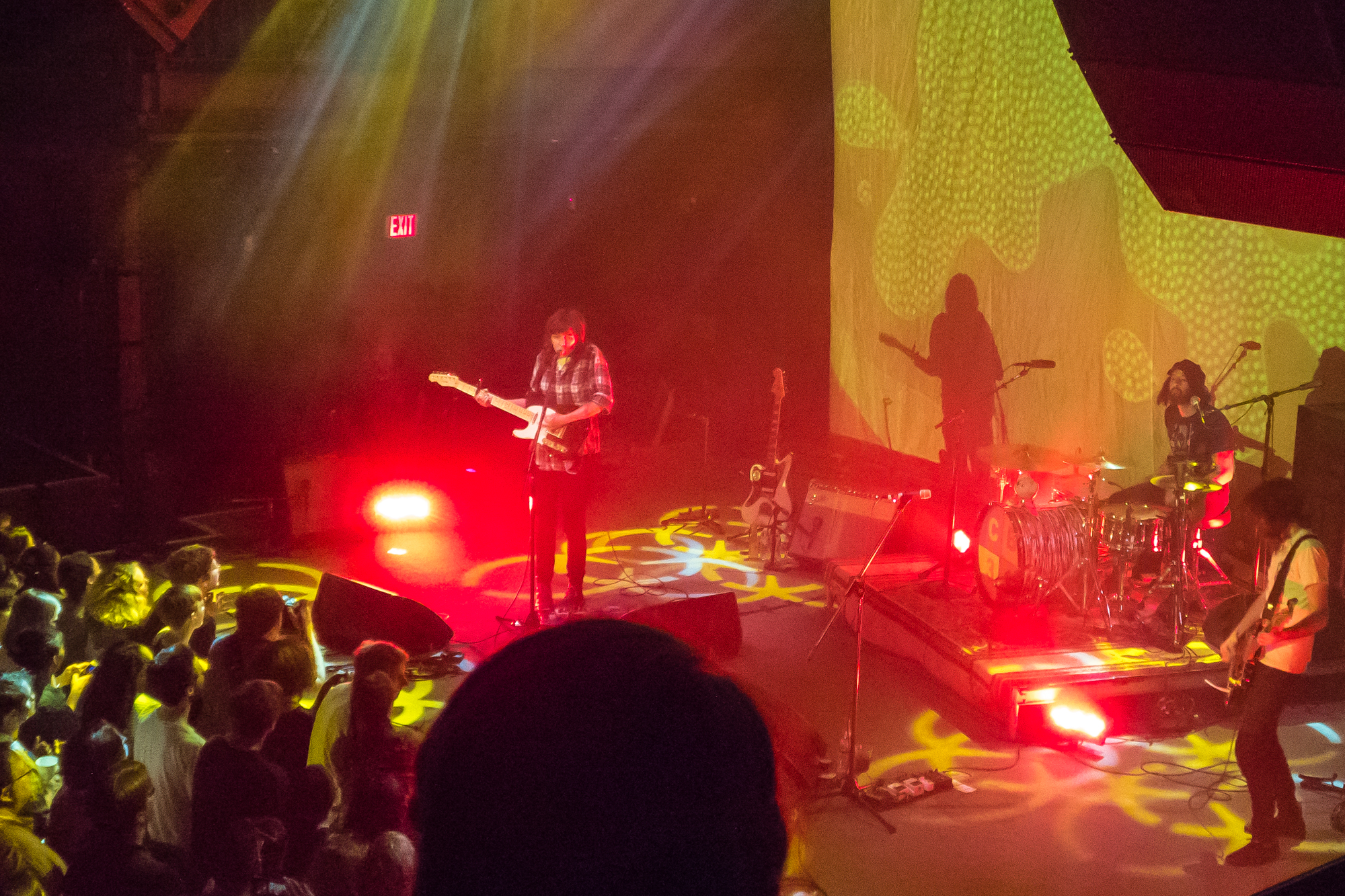
We overheard someone in the audience next to us say that the last time Courtney Barnett played DC, it was at DC9, a venue considerably smaller than the 1000-and-change-sized 930 Club. Given the roars of approval — as loud as we have heard them in 20+ years going to shows in this venue — and the quality of the performance, it seems almost inevitable that she’s going to make the leap to venues a quantum larger.
We love the Australian singer and guitarist’s debut album Sometimes I Sit And Think, And Sometimes I Just Sit, as readers of Tulip Frenzy well know. Sometimes we prefer her real introduction to the States, 2014’s The Double EP: A Sea Of Split Peas. Mostly, though, the hesitancy we had before fully embracing the album was that we were unprepared for the transition, the way the sound had been torqued tighter, louder, with more pop urgency. It would be like riding in your favorite ’73 BMW 2002 and suddenly getting into its most recent 3 Series descendent: familiar, but scary in way, once you put your foot to the pedal and saw how it had been modernized for the Autobahn.
Last night, she played virtually the entire new album, plus a number of our favorite songs from the double EP, and we realized how they both connect, and why we think she’s the strongest talent to emerge since Ty Segall five years ago. For what we liked most about The Double EP: A Sea Of Split Peas was the way she updated the sound of a particular era of British pop music that coincided with the emergence of punk but preceded Power Pop — those early albums by Joe Jackson, Elvis Costello and the Attractions, Ian Dury and the Blockheads, Nick Lowe. Last night, that particular proto-Power Pop song sensibility was apparent — though powered along with a thunder more like Nirvana than any other trio we can remember.

Barnett is a great storyteller, but that may make her sound twee, and she’s anything but: she and her band kick harder than any Aussies we can think of since Radio Birdman. From “Elevator Operator,” which opened the set, to “History Eraser,” which finished the encore, the Courtney Barnett 3 played like a band with twice the instruments. There may come a time when they’ll need sidemen to fill the arenas she’ll headline. Yeah, after a thoroughly entertaining show last night, the first of two sold-out shows at 930, we have no doubt that’s where she’s heading.
Song of the Day # 513 Port Sulphur
So much new vaguely alternative stuff is built on the Motorik Neu! backbeat. It works though so who can blame them. Port Sulphur is a village on the West Bank of the Mississippi in Plaquemines Parish, Louisiana. It's also a band. This is just released courtesy of the Creeping Bent Organisation. And I'm not making that up.
Monday, June 15, 2015
Mixtape - Songs that Steal the 'Be My Baby' Drum Sound # 25 Hunx & his Punx
Side 2 Track 11- 3.42. Pure trash.

Song of the Day # 512 Bread
First track from the first Bread album on Elektra in 1969. They wandered off into the middle of the road and mass mainstream success shortly afterwards but this doesn't sound a million miles away from what Big Star were trying to do on their first two records to much more critical acclaim a couple of years later.
Sunday, June 14, 2015

Odd, Lost Albums # 1 The Four Seasons - Genuine Imitation Life Gazette
So here you go. The fourth consecutive Four Seasons post and again the start of a new, spurious series. The Four Seasons' response to Sergeant Pepper in 1969. Of course not a commercial success but a pretty interesting record, which I'll probably end up on Discogs ordering before very long. And here's a proper record fan talking about it.
B Sides # 1 The Four Seasons
And while we're at it. Third four Seasons post in a row. Might have to make it four. And the start of a new spurious series. B Side to Rag Doll but one of the best things they ever did and far better than the more famous Tremeloes version.
Covers # 9 The Four Seasons
And while we're with the Four Seasons, YouTube played on from Rag Doll eventually to this. Extraordinary work from Frankie Valli. Dylan, for whatever reason, prevents his songs from being posted up there which in turn stops me from putting as much of his stuff as I'd like to up here so in the meantime here you go.
Mixtape - Songs that Steal the 'Be My Baby' Drum Sound # 24 The Four Seasons
Side 2 Track 10 3.01.
' Leaving New York through the Lincoln Tunnel, you drive through the neighborhood known as Hell's Kitchen. On Tenth Avenue the kids have for many years approached stopped cars at traffic lights and wiped their windows hoping for quarters. One afternoon, in 1964, The Four Seasons' Bob Gaudio was leaving the city on his way home to New Jersey. when he noticed that the kid smearing the glass was a girl.
' I saw her face. Just the picture of her face and the clothes, tattered...with holes in her stockings and a little cap on her head.' Gaudio told Fred Bronson, author of The Billboard Book of Number One Hits. She finished her job and stood back as Gaudio searched his pockets for change. To his mortification he had none, The smallest thing he had was a five.
'There was a split second when I said 'I can't give her a five dollar bill.' But I couldn't give her nothing. So I gave her the five dollar bill. The look on her face when I was pulling away - she didn't say 'thank you,' she just stood there with the bill in her hand and I could see her in the rearview mirror, just standing in disbelief in the middle of the street with the five dollars. And that whole image stayed with me; a rag doll was what she looked like.'
Gaudio went home and wrote a song about her. Only in the song the Rag Doll became a young woman and rather than five bucks, the singer wants to offer her his love against the wishes of his family and society. Gaudio says that he and producer Bob Crewe worked for two weeks completing the writing. Then they took the Four Seasons into a New York demo studio, their ordinary headquarters being booked by others, and worked with an engineering crew they'd never met before.
The record they came up with is prototypical Four Seasons, from its crashing drum intro to the piercing glockenspiel and tambourine accoutrements , from Frankie Valli's wild falsetto to the bel canto doo-wop harmonies. As a fantasy about love in America, it's certainly the best ever contrived at a stoplight. As a record it was one last glorious blast of Italian R&B at the top of the charts before the Brits took over for good. The week it fell from Number One it was replaced by 'A Hard Day's Night'. It was the last Number One the Four Seasons ever had.'
Dave Marsh - The Heart of Rock & Soul

Radio Songs
There's something about the radio that feeds into great songs. Sons of Hippies lead me to a quick tribute to the glory of the transistor or car radio.
1. Elvis Costello & the Attractions - Radio, Radio
2. The Modern Lovers - Roadrunner
3. Donna Summer - On the Radio
4. The Smiths - Panic
5. The Ramones - Rock & Roll Radio
6. The Selecter - On My Radio
7. R.E.M. - Radio Free Europe
8. Joy Division - Transmission
9. Rush - Spirit of the Radio
10. OMD - Radio Waves
Sorry, no Video Killed the Radio Star or Radio Ga Ga.
Subscribe to:
Posts (Atom)